
The Electronic Shelf Label (ESL) market is at a pivotal moment. For years, the industry has operated in a fragmented ecosystem where each manufacturer developed its own proprietary protocols. This approach has created costly technological silos: vendor lock-in, high integration costs, innovation stifled by lack of interoperability. An ESL deployment includes not only hardware, but also the hidden costs of this dependency: specialized training, proprietary maintenance, and inability to mix solutions.
The arrival of Bluetooth® 5.4 protocol feature Periodic Advertising with Responses (PAwR) and the publication of ESL Profile by the Bluetooth® SIG are drastically changing the game. EM Microelectronic has reached a decisive milestone by integrating full support for PAwR and the ESL Profile into the SDK of its em | bleu SoC. With its record-breaking dimensions of 1.8x1.8mm and deep sleep consumption of 200nA, the em | bleu pushes the physical limits of what can be integrated into such a compact form factor, offering ESL manufacturers a standards-based solution where extreme miniaturization and energy efficiency converge without compromise.
This article analyzes this technical transformation and explores how the em | bleu implementation meets the concrete requirements of the next-generation ESL systems.
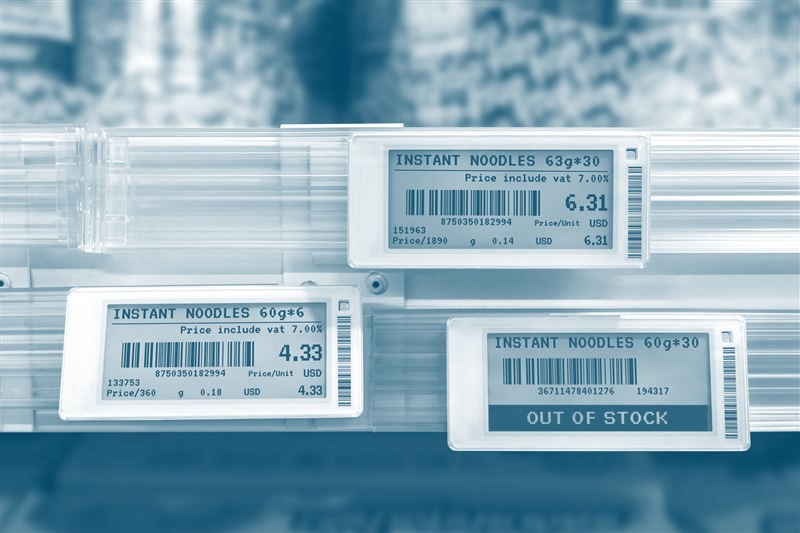
Understanding Bluetooth® ESL Architecture: PAwR and ESL Profile
Modern ESL systems must solve a complex equation: synchronize thousands of tags simultaneously, maintain battery autonomy of several years, while guaranteeing acceptable latency for real-time price updates. Periodic Advertising with Responses operates on an intelligent broadcast model. Imagine a professor simultaneously broadcasting a lecture to a class of 200 students, while receiving their individual questions at coordinated times. PAwR allows an ESL Access Point to periodically broadcast advertising packets containing commands or display data. Tags listen to these broadcasts in a synchronized manner and can respond in allocated time windows without establishing a dedicated connection. This one-to-many architecture changes everything: instead of managing thousands of individual energy-costly connections, the system orchestrates a synchronized ballet where each tag only consumes energy during events that concern it.
An ESL tag using PAwR can remain in ultra-low power mode the majority of the time, only activating to listen to periodic broadcasts. This approach allows for a tenfold increase in battery autonomy compared to traditional architectures maintaining active connections.
ESL Profile complements this mechanism by defining a common language for the ecosystem. The profile standardizes Encrypted Advertising Data to secure transmissions, specifies the GATT services necessary for configuration, and establishes response slots for confirmation. Concretely, a retailer can now deploy tags from vendor A with Access Points from vendor B, and evolve their infrastructure without being locked into a closed ecosystem.
em | bleu: An Architecture Designed for Standards-Based ESL
The em | bleu (EM9305) was designed from the ground up with the constraints of ultra-compact, ultra-low power IoT applications in mind. With dimensions of 1.8x1.8mm, it's the smallest Bluetooth® 5.4 SoC on the market, a critical factor for ESL where every millimeter counts in industrial design. But size is only one aspect of the equation. The chip's internal architecture integrates an ARC EM7D core running at 48MHz, a 32-bit RISC architecture specifically designed for ultra-low-power embedded applications. As detailed in Novel Bits' comprehensive technical guide, the ARC EM7D enables "smaller die size, lower leakage, and longer battery life, especially in ultra-compact or power-constrained designs.". Additionally, em | bleu chip embed 512KB of Flash for firmware and images, 64KB of RAM for display operation buffering, and a sophisticated power management system that natively supports a voltage range from 1.1V to 3.6V.
This power supply voltage flexibility is critical for real-world ESL applications where form factor constraints impose varied choices of batteries or energy harvesting (photovoltaic cells). This on-chip flexibility is complemented by EM Microelectronic’s portfolio of dedicated energy harvesting power management ICs, such as EM8500, EM8502 and EM8504, which enable fully or partially battery-less ESL tags powered by indoor photovoltaic cells while keeping the overall system architecture compact and cost-optimized.
In addition, the integration of DC-DC step-up/step-down and inductorless voltage multiplier eliminates external regulators, simplifying the BoM and increasing overall efficiency.
The em | bleu 's energy profile constitutes its major competitive advantage. In active mode at 3V, the chip consumes 3.1mA in RX and 3.4mA in TX at 0dBm. Deep sleep mode drops to 200nA, and Bluetooth® LE Sleep mode with RAM retention reaches 390nA (32kHz XTAL) or 610nA (internal oscillator). These performances are not just datasheet numbers: the em | bleu recently set a record in the BlueJoule benchmark, the industry reference for measuring real energy efficiency of Bluetooth® LE SoCs. In a typical ESL usage scenario with a standard CR2032 battery, this energy efficiency translates into years of autonomy, allowing significant reduction in maintenance and intervention costs for the installed base.
Network scalability addresses another critical challenge: the Bluetooth® ESL Profile PAwR architecture theoretically allows an Access Point to manage up to 32,640 tags simultaneously, thanks to an addressing system combining 128 groups of 255 tags each. This one-to-many capacity represents a major structural advantage for large-scale deployments, enabling significant reduction in infrastructure requirements and associated CAPEX. The SDK provided by EM Microelectronic includes the complete Bluetooth® stack with native PAwR and ESL Profile support, comprehensive project examples for both the ESL Tag and the Access Point, high-level APIs, and debug tools to reduce time-to-market from several months to a few weeks.
Business Case: Concrete Applications and Ecosystem Vision
In a 2,500m² (26,900 ft²) grocery store with 15,000 SKUs, an ESL system based on the em | bleu enables dynamic real-time price updates synchronized with ERP systems. PAwR's low latency enables dynamic pricing and real-time inventory management strategies impossible with slower protocols. For a multi-store chain deploying 500,000 tags across 50 stores, the interoperability of open standards allows negotiating with multiple vendors, creating competition that reduces unit costs while facilitating centralized management and progressive fleet evolution.
Beyond pure ESL, the em | bleu fits into a broader vision of connected retail. Tags become communicating hubs integrating additional sensors (temperature, motion, light) and integrating with POS systems, analytics platforms, and mobile applications. The open Bluetooth® architecture ensures a future-ready platform, capable of evolving at the pace of IoT retail ecosystem innovations.
Towards an Open and Competitive ESL Ecosystem
The transition to open standards, Bluetooth® PAwR and ESL Profile represent a structural transformation of the ESL market. The em | bleu, with its record dimensions (1.8x1.8mm), exceptional energy efficiency (200nA in deep sleep), system flexibility (1.1V to 3.6V), and network scalability (32,640 tags per Access Point), offers a production-ready solution that pushes the limits of hardware optimization.
To explore the technical capabilities of the em | bleu and access PAwR and the ESL Profile SDK, visit the em | bleu product page. To discuss your system architecture with our engineers and the developer community, join our dedicated technical forum.