
With the introduction of the BlueJoule benchmark, the industry finally has an open and reproducible way to measure real-world Bluetooth® energy efficiency. In this inaugural ranking, EM Microelectronic’s em | bleu not only takes the top spot but sets a new standard for battery life, delivering up to twice the autonomy of competing solutions from leading brands such as Nordic, Silicon Labs, and Texas Instruments.
The Critical IoT Equation: Battery Life as a Viability Factor
In the connected device landscape, battery life has become the defining factor that separates viable products from impractical concepts. Medical, industrial, and retail device manufacturers witness this daily: limited battery life generates product returns, while battery replacement logistics costs often exceed the devices themselves. For electronic shelf labels or industrial asset tracking, this economic barrier inhibits mass IoT adoption. In Bluetooth® Low Energy sensors that spend over 99% of their time in sleep mode between data transmissions, every microampere saved translates directly into months or years of additional autonomy.
An Outstanding Result Validated by an Independent Open-Source Benchmark
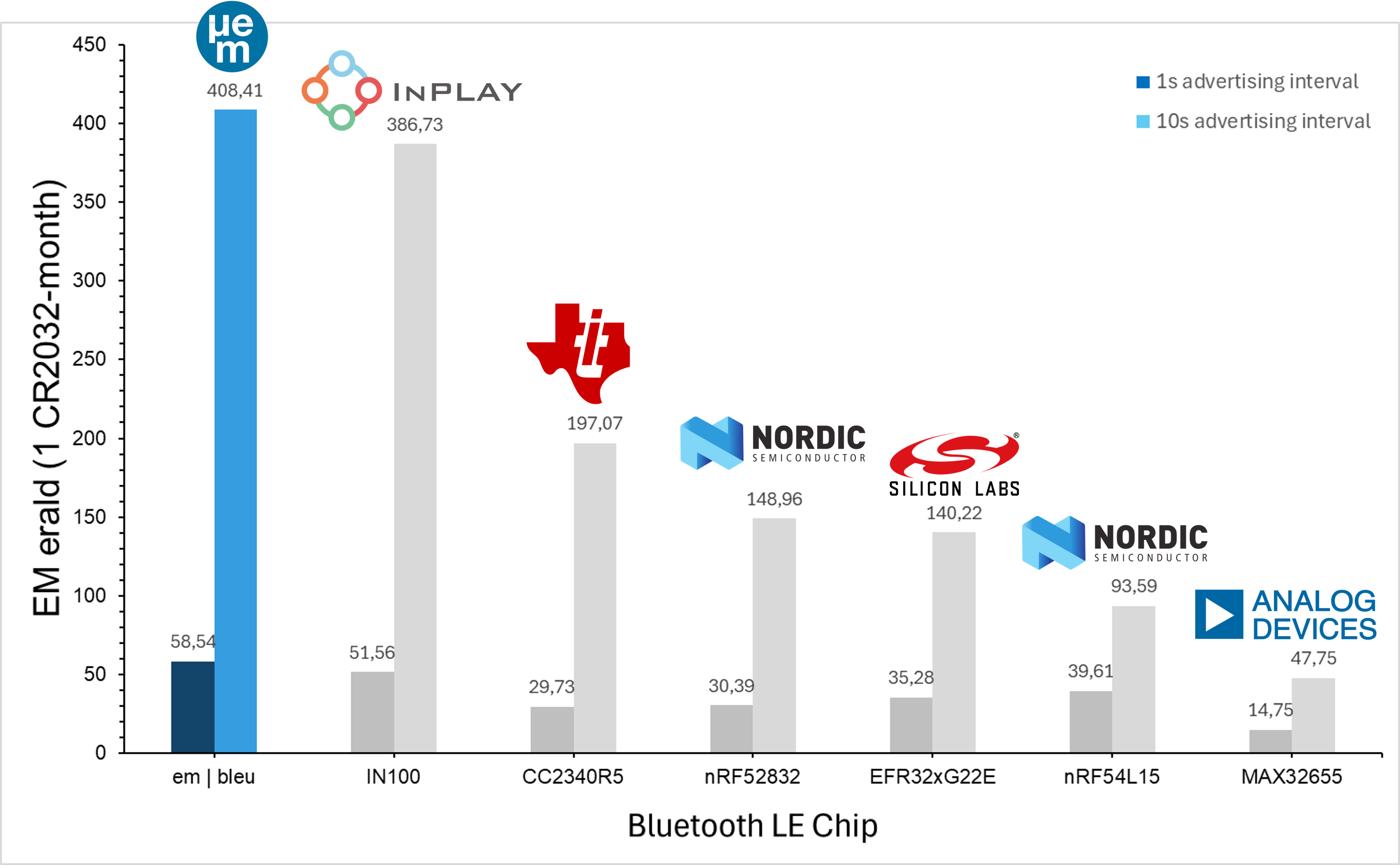
EM Microelectronic's em | bleu Bluetooth® Low Energy chip has emerged as the clear leader in the BlueJoule benchmark with a score of 408 EM•eralds 10-second advertising period test, representing typical always-on sensor applications. In the more demanding 1-second advertising period scenario, typical of real-time asset tracking applications requiring frequent location updates, the em | bleu achieved also the best result with 58.5 EM•eralds. Developed by the EM Foundation, one EM•erald point equates to approximately one month of operation from a CR2032 coin cell battery.
BlueJoule Benchmark Performance Comparison
| Chip | 10s advertising period (years on CR2032) | vs em | bleu | 1s advertising period (years on CR2032) | vs em | bleu |
|---|---|---|---|---|
| EM Microelectronic em | bleu | 34.0 years | — | 4.9 years | — |
| InPlay IN100 | 32.3 years | -5.1% | 4.3 years | -11.9% |
| Texas Instruments CC2340R5 | 16.4 years | -51.7% | 2.5 years | -49.2% |
| Nordic Semiconductor nRF52832 | 12.4 years | -63.5% | 2.5 years | -48.3% |
| Silicon Labs EFR32BG22 | 11.7 years | -65.7% | 2.9 years | -39.7% |
| Nordic Semiconductor nRF54L15 | 7.8 years | -77.1% | 3.3 years | -32.3% |
The BlueJoule benchmark is the result of a close collaboration between Bob Frankel and Mohammad Afaneh of Novel Bits, who combined their complementary expertise in embedded systems and Bluetooth® Low Energy technology. Behind the framework itself stands the EM Foundation, an independent nonprofit organization unaffiliated with EM Microelectronic, which designed the program to offer an open, transparent, and reproducible methodology for measuring real-world Bluetooth® advertising scenarios using precision JouleScope JS220 analyzers. Unlike manufacturer-provided specifications that often reflect ideal laboratory conditions, this open-source framework enables transparent and verifiable results. All test methodologies, captured data, and analysis tools are publicly available on GitHub, enabling independent verification and community contributions. A comprehensive webinar presenting the BlueJoule program and benchmark results is available for viewing.
Concrete Benefits Across Four Key Markets
The BlueJoule benchmark results translate into tangible advantages for several critical application categories. In battery-powered medical devices, including health monitors, diagnostic patches, and wearable sensors, the em | bleu chip enables significantly extended operational lifetimes on small coin cell batteries, reducing replacement frequency and improving patient compliance. When manufacturers can double the lifespan of a disposable health monitoring patch, the value proposition becomes compelling.
For fitness trackers and smartwatches, manufacturers can either extend battery life by 40% or more with existing coin cells, or reduce device thickness while maintaining current runtime, a critical competitive advantage in the consumer wearables market. In retail deployments, electronic shelf labels can operate for years on standard button cells, transforming the economics of digital price tag infrastructure where battery replacement costs have historically limited adoption.
For smart home sensors and remote controls, the chip enables true "fit-and-forget" deployments with battery lifetimes exceeding 10 years from standard alkaline cells. Perhaps most transformatively, the em | bleu's ability to operate from as low as 1.1V unlocks energy harvesting applications powered by solar cells, thermoelectric generators, or RF energy, enabling battery-free IoT devices that were previously impractical with higher-voltage Bluetooth® LE solutions.
A Fundamentally Different Architecture
The em | bleu chip's performance stems from deliberate architectural choices centered on extreme power optimization. At the core of this efficiency lies the Synopsys ARC EM7D processor, a 32-bit RISC architecture specifically designed for ultra-low-power embedded applications. As detailed in Novel Bits' comprehensive technical guide, the ARC EM7D enables "smaller die size, lower leakage, and longer battery life, especially in ultra-compact or power-constrained designs."
Most Bluetooth® LE chips optimize for active-mode efficiency, a relevant approach for data-intensive applications like audio streaming. But in IoT sensors that transmit a few bytes every few seconds, devices spend 99% of their time sleeping. The em | bleu's architecture, achieves 0.5 μA sleep current while maintaining full RAM retention, compared to an industry average of 2-5 μA. This single specification difference multiplies into years of battery life in real-world deployments.
The chip also integrates a sophisticated multi-mode power management system that dynamically adjusts voltage rails and selectively powers functional blocks based on real-time application needs. A flexible DC-DC converter supports operation from 1.1V to 5V, with optimized solutions for 1.5V and 3V batteries.
Validated by 500 Million Deployed Devices
These benchmark results validate what EM Microelectronic's Bluetooth® customers have been experiencing in production across more than 500 million deployed devices including it’s highly successful predecessor the EM9304. When a building automation provider can eliminate 90% of their battery replacement interventions, connectivity transforms from a maintenance burden into a viable long-term solution.
Energy efficiency doesn't just extend battery life, it enables entirely new product categories. When a Bluetooth® sensor can operate for a decade from a single coin cell, it becomes possible to embed connectivity into industrial equipment, building infrastructure, and supply chain packaging that previously couldn't justify the maintenance overhead. The em | bleu's 1.8×1.8mm WLCSP package, the world's smallest Bluetooth® 5.4 System-on-Chip, fits into space-constrained applications such as smart rings, smart pens, jewelry, hearing aids, and implantable medical devices where competing solutions simply cannot physically integrate.
With the em | bleu, customers are creating products that were fundamentally impossible with previous-generation Bluetooth® LE chips, from decade-long sensor deployments to entirely battery-free solutions powered by energy harvesting.
Learn More About the em | bleu
The em | bleu chip is currently in volume production and available through EM Microelectronic's global distribution network. It supports Bluetooth® Core 5.4 specifications including LE 2M PHY, Coded PHY for extended range, Direction Finding for asset tracking and PAwR and ESL features for electronic shelf label applications.
Development tools, including the em | bleu DVK development kit available on DigiKey, the software development kit, FCC/CE certification support, and complete technical documentation are available through the em developer website. For detailed technical information about the em | bleu chip, visit the official em | bleu product page.
This article is not sponsored by or affiliated with the EM Foundation.